Whole spices inside a paper bag or glass jar are essentially dormant storage vaults. Seeds like coriander, cumin, and fennel lock their aromatic compounds behind fibrous husks and dried cell walls. When you apply gentle heat to these spices, the warmth liquefies the trapped essential oils, expands the tiny pockets of moisture inside the seed cells, and coaxes the volatile compounds into the air. This process transforms raw, vegetal flavors into rounded, nutty, and savory notes that anchor a dish.
Yet dry toasting sits on an unforgiving knife-edge. The very compounds responsible for deep flavor are delicate chemical structures that break down quickly under intense heat. A cook can spend three minutes waiting for an aroma to appear, only to ruin the entire batch eight seconds later because the pan grew too hot. Learning to toast whole spices without charring these volatile oils is one of the most reliable ways to improve your everyday cooking, and it relies on basic physics rather than guesswork.
The Danger Zone Between Fragrant and Burnt
Why do spices turn bitter so fast? The answer lies in the chemistry of volatile oils. In culinary science, volatile oils are natural organic compounds such as linalool in coriander, cuminaldehyde in cumin, and anethole in fennel. The word volatile simply means these molecules evaporate at relatively low temperatures. When they evaporate, they float into your nasal passages, which is how you perceive their fragrance. However, these oils have low flashpoints and degrade when exposed to temperatures above 175 degrees Celsius.
Dry toasting relies on two distinct events happening in the pan. First, the heat dries out surface moisture and softens the tough cellulose fibers of the seed hull. Second, it triggers mild Maillard reactions, which are the chemical recombinations between amino acids and reducing sugars that create roasted flavors. But if the pan temperature climbs past 180 degrees Celsius, the oils do not simply evaporate; they oxidize and scorch, creating acrid, carbonized compounds that taste medicinal and astringent.
To keep spices in the sweet spot where flavor develops without destruction, you need to manage heat transfer carefully. The following table illustrates how different key spices respond to dry heat and where their primary flavor compounds sit.
| Spice | Primary Volatile Compound | Tolerance to Dry Heat | Target Toasting Time |
|---|---|---|---|
| Coriander Seed | Linalool | Moderate to High | 2 to 3 minutes |
| Cumin Seed | Cuminaldehyde | Moderate | 90 to 120 seconds |
| Fennel Seed | Anethole | Low to Moderate | 60 to 90 seconds |
| Green Cardamom | Terpinyl acetate | Moderate (in pod) | 2 to 3 minutes |
| Brown Mustard | Allyl isothiocyanate | Low | 30 to 45 seconds |
Once an essential oil chars, there is no culinary remedy. You cannot balance charred cumin with acid, salt, or sugar. The burnt compounds will permeate the cooking liquid and dominate the finished sauce. If the seeds turn black or give off sharp white smoke, the only sensible choice is to discard them, wash the pan, and begin again.
Choosing Heavy Pans for Uniform Heat
Have you ever noticed that a thin skillet scorches pancakes in the center while leaving the edges pale? The same issue ruins whole spices. Thin pans, especially inexpensive pressed aluminum or lightweight carbon steel, suffer from thermal hot spots. The metal right above the gas flame or electric element reaches 220 degrees Celsius, while the metal two inches away sits at 130 degrees Celsius. When small seeds roll across these hot zones, their thin skins scorch instantly.
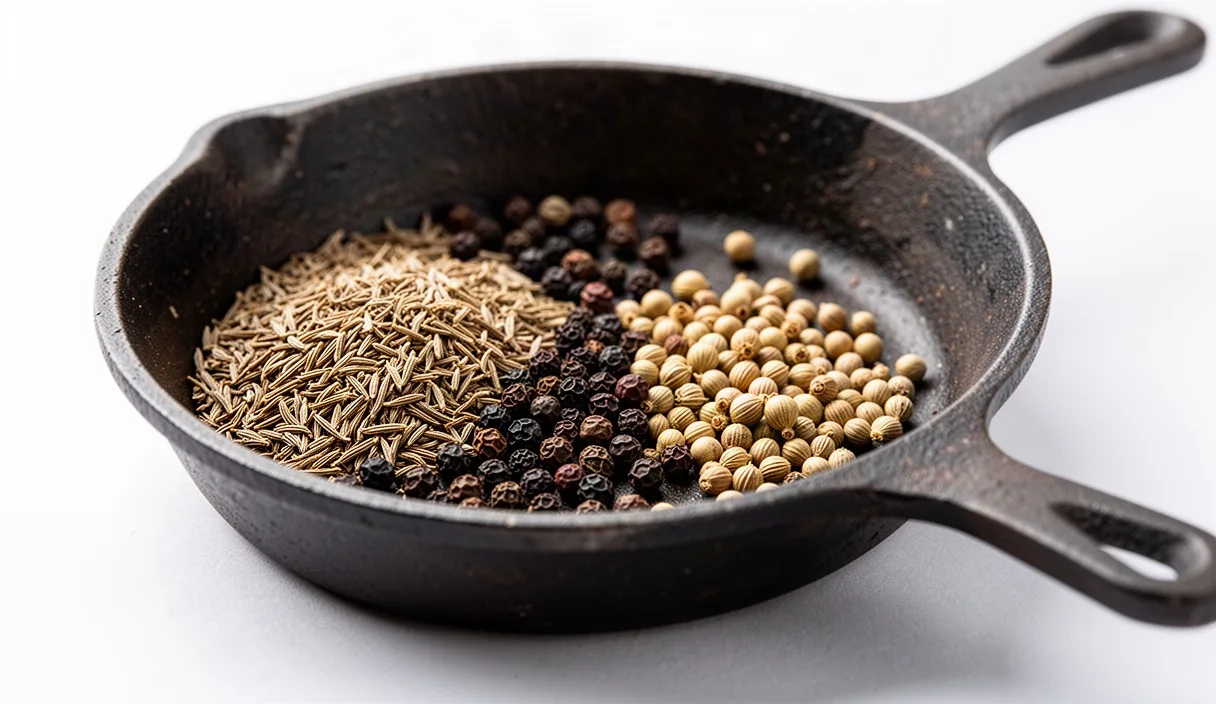
A heavy pan acts like a thermal battery. Cast iron, enameled cast iron, and multi-ply stainless steel with a thick core absorb thermal energy slowly and spread it evenly across the base. When you drop room-temperature seeds into a heavy pan, the surface temperature does not wildly fluctuate. Instead, the pan delivers a consistent, steady wash of warmth that gently warms the seed from its outer shell to its interior core.
Consider the qualities of common pan materials before setting up your stove:
- Multi-ply Stainless Steel: Excellent thermal distribution. The lighter color of the metal makes it easy to track changes in seed color, giving you visual feedback alongside scent cues.
- Cast Iron: Superior heat retention. It provides exceptionally even heat once fully warmed, but it holds onto that heat for a long time, which makes rapid cooling critical.
- Nonstick Cookware: Poorly suited for dry toasting. Nonstick coatings can degrade and release harmful fumes when heated dry without oil, butter, or liquid covering the surface.
Keep your flame on medium-low or medium. A common mistake is heating the pan over high heat to speed up the job. High heat merely toasts the outer micrometer of the seed while leaving the center raw, followed by burning the shell before the fragrant interior oils have liquefied.
Using Smell Rather Than Color as Your Guide
Why is relying on your eyes a risky strategy when toasting spices? Simply put, many spices are already brown, black, or deep tan. Black peppercorns, dark brown cumin, allspice berries, and cloves offer very little visible contrast when their surface begins to burn. If you wait until a clove or a cumin seed turns noticeably darker, the delicate volatile oils have likely already boiled off or scorched.
Your sense of smell is far more sensitive to chemical changes than your eyes are to shade shifts. When spices begin to warm, they move through three recognizable aromatic stages:
- The Raw Stage: For the first 30 to 45 seconds, the scent is dusty, herbal, and faint, similar to dried straw or dried grass. Moisture is leaving the husk.
- The Bloom Stage: As the pan passes approximately 130 degrees Celsius, the essential oils evaporate. The smell becomes round, sweet, warm, and fills the air immediately above the skillet. This is the peak moment to remove the pan from heat.
- The Acrid Stage: If left on heat for another 15 to 20 seconds, the aroma turns sharp, peppery, and irritating to the throat. This signals oil breakdown and cellulose scorching.
To read these stages accurately, practice gentle wafting. Hold your face roughly twelve inches back from the edge of the skillet and use your cupped hand to sweep the rising air toward your nose. Never place your face directly over the pan. Spices release pungent volatile vapors that can irritate your eyes and respiratory lining, especially when working with chilies, mustard, or peppercorns.
The Immediate Cool-Down Step
What happens if you turn off the burner and leave the toasted spices sitting in the skillet? They keep cooking. This phenomenon is called carryover cooking, which refers to the heat retained by the cookware continuing to transfer energy into the food long after the heat source is extinguished. A heavy cast iron skillet can retain enough heat to scorch seeds for five minutes after the gas flame is turned off.
To halt the cooking process the moment the spices reach peak fragrance, you must break contact between the seeds and the heated metal immediately. Prepare a landing zone before you strike a match or turn on the burner. A cold ceramic plate, a wide stainless steel prep bowl, or a small baking sheet works best.
Follow these steps to cool your spices properly:
- Place your cold plate or rimmed metal tray directly beside the stove before lighting the burner.
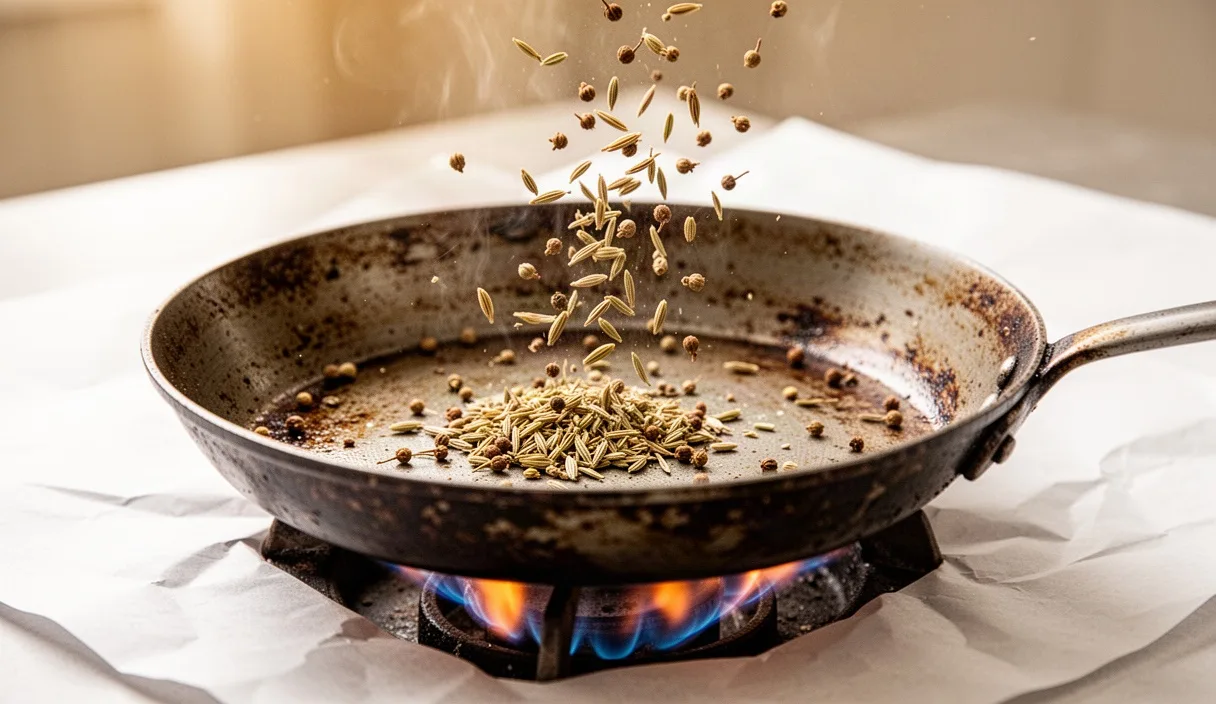
- Keep the seeds moving in the pan during the final thirty seconds by swirling the skillet or stirring continuously with a wooden spoon.
- The instant the aroma blooms into that sweet, nutty profile, tip the contents of the pan onto the cool plate in a single layer.
- Spread the seeds out so they do not insulate each other. If left in a tall mound, the seeds in the center will steam and continue to cook in their own trapped heat.
Allow the seeds to come down to room temperature completely before grinding them. If you pour hot spices into a mortar or a motorized spice grinder, the trapped heat creates condensation inside the vessel. This moisture turns the freshly crushed spices into a sticky, clumpy paste and quickly dulls the edge of motorized steel grinder blades.
Adjusting Heat for Tiny Mustard Seeds
Can you toast black or brown mustard seeds the same way you toast large cardamom pods or cinnamon bark? No, because their surface-area-to-mass ratio is entirely different. A tiny mustard seed has a massive amount of surface area relative to its tiny volume of interior moisture. As a result, heat reaches the core of a mustard seed in a fraction of the time it takes to penetrate a thick star anise petal or coriander pod.
Mustard seeds also behave differently because of their physical structure. Inside every mustard seed sits a drop of bound moisture surrounded by a tough, elastic seed coat. When heated dry, that internal moisture turns to steam. Because the hull is durable, steam pressure builds up until the seed hull fractures violently, causing the seed to jump into the air with a distinct popping sound. In Indian cooking traditions, this technique is central to tempering, though it is often done in hot fat rather than completely dry.
When dry toasting mustard seeds without fat, you must use a specific approach to avoid shooting hot seeds across your kitchen or scorching them:
- Use low to medium-low heat. Do not let the pan become piping hot before adding the seeds.
- Keep a lightweight lid or a fine mesh splatter screen in your hand before the seeds enter the skillet.
- Add the mustard seeds and swirl the pan constantly over the flame.
- Place the lid slightly askew over the pan once the first seed pops. This allows steam to escape while containing erratic popping seeds.
- Count between fifteen and twenty pops, which should take roughly 30 to 45 seconds total, then immediately dump the seeds onto your cool plate.
If you see mustard seeds turn dull gray or produce acrid, choking smoke, the sulfurous compounds within the seed have burned. Throw them out. Perfectly toasted mustard seeds should look slightly matte and smell nutty, not acrid or bitter.
Common Mistakes to Avoid
Even experienced home cooks run into trouble when working with dried aromatics. Being aware of these frequent missteps will help you avoid wasted ingredients:
- Toasting mixed spice blends together: Throwing whole cloves, coriander, cumin, and mustard seeds into the pan at the same time guarantees uneven results. The mustard seeds will burn to charcoal before the thick cloves even warm through. Always toast seeds of different sizes separately, or add smaller seeds toward the very end of the process.
- Toasting pre-ground spices dry: Ground spices consist of pulverized particles with no protective husks. Putting ground cumin or ground cinnamon into a dry skillet exposes the delicate volatile oils directly to hot metal, burning them in less than ten seconds. Ground spices should almost always be bloomed gently in warm oil or butter, not dry toasted.
- Walking away from the cooktop: Toasting is not a passive task. Because the shift from optimal toasting to burnt oils takes roughly twelve seconds, you must stay at the stove, watching the pan and moving the seeds continuously.
- Crowding the pan: If you pile whole spices three layers deep in a small skillet, they will trap steam and cook unevenly. Keep the spices in a single, loose layer across the bottom of the pan so that every seed receives direct, identical heat.
Practical Next Steps for Your Kitchen
To build your confidence with dry toasting, start small. Take a single tablespoon of whole cumin or coriander seeds and place them in a small, heavy skillet over medium-low heat. Do not worry about cooking dinner yet. Treat this single tablespoon as a calibration test for your stove and cookware.
Swirl the pan constantly and pay close attention to your senses. Notice the initial damp smell that rises after thirty seconds, followed by the rich, warm fragrance that appears around the ninety-second mark. Tip the seeds onto a white ceramic plate, let them cool completely, and crush a few between your fingers. Taste one. It should taste savory, crisp, and fragrant, without any bitter, carbonized aftertaste.
Once you are comfortable with single-spice toasting, you can incorporate this habit into your regular meal preparation. Toast your seeds dry, let them cool, grind them coarsely in a mortar or spice mill, and add them to your curries, braises, vinaigrettes, and dry rubs. This simple five-minute technique fundamentally changes how spices behave in your food, turning flat pantry seasonings into vibrant, complex layers of flavor.