If you have ever eaten flat rice noodles from a busy night-market stall, you know the distinct flavor that sets commercial stir-fries apart from home cooking. The noodles carry a delicate scorch that never tastes like burnt fuel or charcoal. Instead, the dish offers a complex, savory aroma that sits somewhere between browned butter, toasted wood, and crisp roast chicken skin. In Cantonese cooking, this elusive quality is called wok hei, which translates literally to the breath of the wok.
What causes this unmistakable aroma? Many home cooks assume it requires a mysterious ancestral seasoning technique or an ancient family heirloom pan. The truth rests entirely on culinary physics, heat mechanics, and the interaction of oil, steam, and metal. When you break down the process into observable physical reactions, wok hei becomes an understandable result of extreme temperatures, airborne fat particles, and precise surface geometry.
What Breath of the Wok Means in the Kitchen
To understand the breath of the wok, we must first look at what happens to food molecules under normal cooking conditions compared to high-heat conditions. When you cook sliced onions or beef in a regular nonstick pan on a standard electric stove, the ingredients sit in pool of their own juices. As water leaves the meat fibers, the pan cools down, dropping to around 100 degrees Celsius, which is the boiling point of water. At that temperature, food simmers instead of browning, yielding a muted taste and a soft texture.
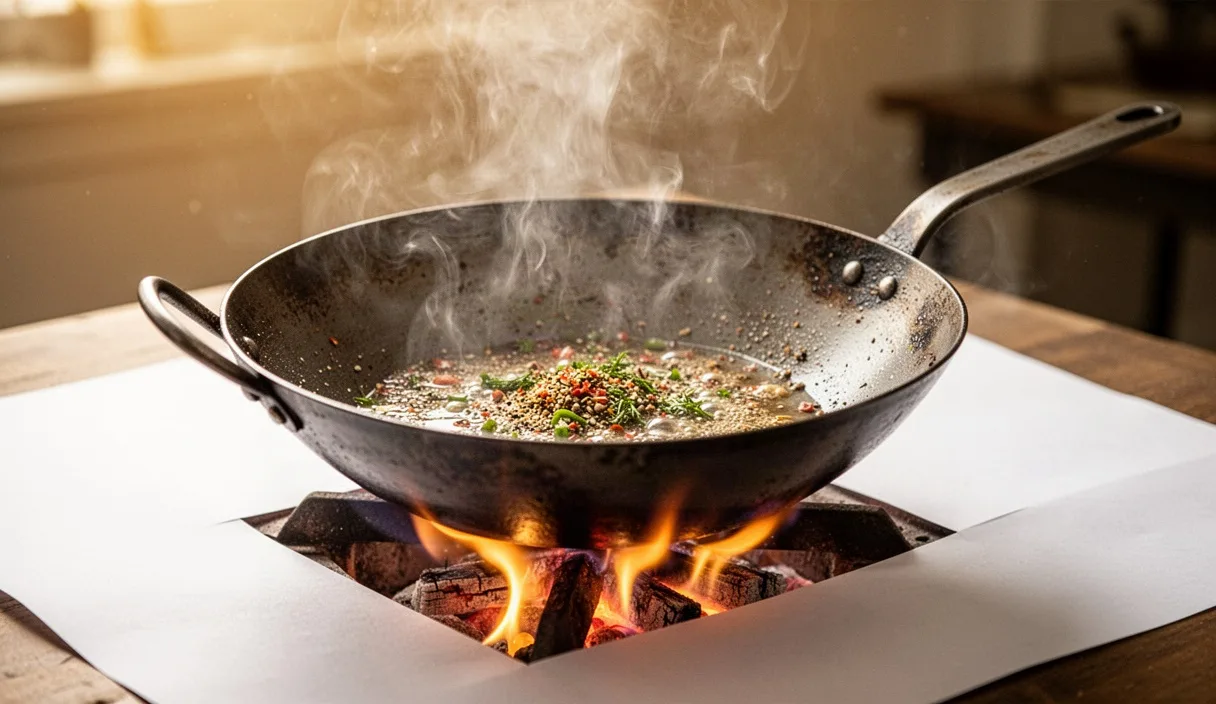
In a professional Cantonese kitchen, the heat is fundamentally different. The burner beneath the pan sounds like a miniature jet engine, generating thermal energy that pushes the metal pan well beyond 200 degrees Celsius, often reaching 320 degrees Celsius or higher. At these temperatures, two fundamental culinary processes happen almost instantly: the Maillard reaction and caramelization. The Maillard reaction is a chemical dance between amino acids from proteins and reducing sugars, which forms hundreds of new aromatic compounds. Caramelization is the thermal breakdown of sugars without proteins, producing rich, nutty notes.
However, wok hei is more than just rapid browning. A steak seared in a heavy cast-iron skillet develops deep Maillard browning, but it does not taste like Cantonese beef chow fun. The unique dimension of wok hei comes from an airborne transformation. It is the sensory consequence of fat, moisture, and smoke recombining in the air above the rim of the pan, settling back onto the food as an aromatic mist during each toss.
Oil Droplet Vaporization and Micro-Ignition
Why does wok cooking produce that specific toasted scent that standard pan-frying cannot duplicate? The secret lies in what happens when the chef tosses the food through the rising thermal plume above the pan. During this motion, known as the wok toss, food slides up the curved front wall of the pan, shoots into the air, and tumbles back into the center. This is not done for theatrical flair. It is a precise physical method designed to create aerosolized oil droplets.
As the food lifts from the metal surface, tiny droplets of cooking oil become suspended in the air. Think of spraying water from a fine garden hose nozzle into the wind; the solid stream breaks apart into millions of micro-droplets. Above the wok, the air temperature can exceed 250 degrees Celsius. When these microscopic oil droplets contact this superheated air and brush past the edge of the open flame beneath the pan, they vaporize. In commercial kitchens with intense burners, these droplets experience micro-ignition: tiny, imperceptible flashes of combustion that singe the oil mist without setting the whole pan on fire.
This vaporized, slightly pyrolyzed oil settles back onto the surface of each noodle, vegetable strip, and slice of meat. Pyrolysis is the chemical decomposition of organic materials at elevated temperatures without open burning. When oil undergoes partial pyrolysis in midair, it produces volatile aromatic chemicals, including aldehydes, pyrazines, and furans. These molecules bond with the moisture evaporating from the food, creating a glossy, intensely fragrant coating that does not feel heavy or greasy on the tongue.
Why Metal Thickness and Shape Dictate Heat Transfer
Why do cooks reach for a thin carbon steel wok rather than a thick Dutch oven or a heavy skillet? The answer comes down to thermal conductivity and responsive thermal mass. In Western cooking, a thick cast-iron pan is prized for its ability to hold heat for a long time, acting like a large brick that retains warmth even if you toss cold steaks onto it. In wok cookery, heavy heat retention works against you because you need the cooking surface to change behavior in seconds.
A traditional Cantonese wok is pressed or hand-hammered from carbon steel that is usually between 1.2 and 1.8 millimeters thick. Because the metal is thin, heat transfers from the burner through the steel directly into the ingredients with minimal delay. When you want maximum heat, you open the gas valve, and the bottom of the wok spikes in temperature within three seconds. When you want to add delicate aromatics like minced garlic or scallions, you can tilt the pan or pull it off the fire, and the metal cools rapidly, preventing the alliums from turning bitter and black.
The bowl-like geometry creates three distinct cooking zones across a single continuous piece of steel:
- The Floor: The hottest section directly above the burner, reaching temperatures over 260 degrees Celsius, ideal for searing meat strips in single-second bursts.
- The Sloped Walls: A moderate-temperature zone around 160 to 190 degrees Celsius, where seared ingredients rest to hold their heat without burning while new items hit the floor.
- The Upper Rim: A cooler resting area where sauces cling to the hot metal to reduce, evaporate their excess water, and caramelize before running down into the center.
| Material | Typical Thickness | Response Time to Heat Adjustments | Primary Strength in Stir-Frying |
|---|---|---|---|
| Carbon Steel | 1.2 to 1.8 mm | Under 4 seconds | Direct heat conduction, rapid tossing, balanced weight |
| Cast Iron (Western) | 3.5 to 5.0 mm | Over 45 seconds | High heat storage, poor tossing ease, sluggish reaction |
| Multi-Ply Stainless Steel | 2.5 to 3.0 mm | 15 to 25 seconds | Even heat across base, prone to sticking without excessive oil |
Cooking in Small Portions to Prevent Steaming
One of the most frequent questions from home cooks is: "Why does my stir-fry turn into a watery stew?" The culprit is simple moisture overload. Raw meats and crisp vegetables consist primarily of water. Sliced chicken breast contains roughly 74 percent water, while bok choy and bean sprouts often contain more than 92 percent water. When moisture hits hot oil and metal, it immediately tries to turn into steam.
If you drop 400 grams of cold beef slices and 300 grams of damp vegetables into a wok at the same time, the massive thermal load drops the surface temperature of the metal beneath the evaporation threshold. Instead of the water flashing into dry steam and blowing away into the room, it collects at the bottom of the bowl. At that point, your food is no longer frying; it is poaching in its own juices. You lose all hope of achieving Maillard reactions, and any chance of oil droplet vaporization vanishes.
To avoid this swamp effect, professional cooks follow a disciplined batch routine. They work with portions that weigh no more than 200 to 250 grams at a time. By keeping the mass of food small relative to the volume of the pan, the pan never cools down enough for liquid water to gather. The moisture flashes off within fractions of a second, leaving the oil free to conduct heat directly against the dry surface of the ingredients.
Adapting the Technique to Home Gas Burners
A commercial Chinese wok range produces between 50,000 and 150,000 British Thermal Units (BTU) of heat per hour. By comparison, a quality home residential gas range typically tops out between 9,000 and 18,000 BTU per hour on its largest burner. That gap might seem insurmountable, but you can build a bridge between commercial gear and home stoves by applying smart thermal management.
Since your home burner cannot supply immense heat on demand, you must accumulate and preserve the heat you have. Here is how to prepare a stir-fry setup on a standard domestic gas cooktop.
Preheat the Steel Beyond Normal Limits
Place your seasoned 14-inch carbon steel wok over your most powerful gas burner without any oil. Turn the flame to its highest setting and allow the metal to sit over the fire for three to four minutes. You will see faint blue wisps of light smoke rising from the seasoned patina of the metal. If you flick a drop of water onto the surface, it should not merely boil; it should bead up and dance rapidly across the metal before vanishing within two seconds.
Dry Every Surface Thoroughly
Water is the enemy of the thermal sear. After washing leafy greens or cutting bell peppers, run them through a salad spinner and pat them with clean kitchen towels. For meats, use paper towels to press away surface fluids before tossing the meat in a light starch slurry. A thin coating of cornstarch bonds with the internal juices of the meat, creating an insulating shield that keeps moisture inside the meat fiber rather than letting it bleed onto the pan floor.
Sear in Strict Sequence
Cook your meal using three independent cycles rather than dumping everything in simultaneously:
- Sear the Proteins: Swirl one tablespoon of a high-smoke-point oil, like refined peanut or rice bran oil, around the perimeter of the hot wok. Add your protein in a single layer. Let it sit untouched for 30 seconds to establish a crust, toss once, cook for another 30 seconds, then dump the meat into a side bowl.
- Blister the Aromatics and Vegetables: Return the empty wok to the burner for 60 seconds to build the heat back up. Add another half-tablespoon of oil, toss in the hardy vegetables, cook them until charred at the edges, and transfer them out next to the protein.
- Recombine and Glaze: Reheat the pan until smoking hot once more. Return the cooked items to the center, pour your mixed sauce around the high sloped walls of the pan rather than directly on top of the food, and toss constantly for 20 to 30 seconds until the sauce reduces and coats every bite.
Common Mistakes
The most common failure in home wok cooking is using cold meat straight from the refrigerator. Cold proteins act like an ice cube dropped into hot soup, chilling the steel instantly. Always pull proteins out of the fridge 20 minutes before cooking so they reach cool room temperature.
Another frequent error is crowding the pan with too much sauce. When liquid sauce hits the center of a wok, it floods the heating zone and stops the browning process. Sauce must always be introduced along the superheated perimeter walls. This technique causes the liquid sugars to brown against the hot metal while running down, lending a rich glaze rather than creating a soggy broth.
Finally, cooks often pick the wrong oil. Extra virgin olive oil, unrefined sesame oil, and butter break down into acrid, bitter smoke below 190 degrees Celsius. To generate true wok hei safely, you must select fats with smoke points above 230 degrees Celsius, such as refined peanut oil, canola oil, avocado oil, or rendered pork lard.
Practical Next Steps
If you want to master this method, do not begin with a complicated dish featuring ten ingredients. Start with a simple test recipe that has minimal water content: dry-fried flat rice noodles with bean sprouts and scallions, or simple sliced cabbage with dried chilies. These ingredients allow you to observe how metal temperature and tossing motions interact without fighting excess liquid.
Before turning on the burner, arrange every component in small bowls right next to your stove. Once the carbon steel reaches full heat, you will not have time to mince garlic or measure soy sauce. The entire active cooking process should take under four minutes from the moment the first drop of oil touches the steel to the moment the finished food lands on your plate.